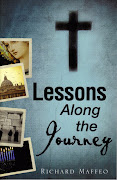
I posted this about a year ago. It also appears in my third book, Learning to Lean.
-------------
They brought Him to the place of Golgotha (which is translated Place of a Skull) (Mark 15:22).
I haven’t slept for two days. His eyes still haunt me.
It began when the governor handed me the placard. “Nail it above his head when you’re done crucifying him,” Pilate ordered. I smirked when I read it. “Jesus the Nazarene, King of the Jews.”
Some ‘king,’ I sneered.
I hated my assignment to this dung-hole called Palestine. I was hot, thirsty and dripping sweat when we finally reached the hilltop. And not a little angry.
We nailed him to the cross and hoisted it upright. He groaned as it rocked back and forth before settling into the hole we’d dug for it. I set soldiers around the site perimeter for protection, while I sat a few yards from the crosses. And watched. And waited.
And then remembered the placard.
I cursed under my breath, pushed myself to stand and grab a ladder. I didn’t care that the top rung bounced off his shoulder as I climbed toward the top. When I was at eye level I stopped, sneered at him and shoved the placard in front of his face.
“What d’ya think, Jew? Quite the king, are ya?”
I spit at him. My saliva dripped from his cheek and caught in his beard. How I despised that Jew.
And that’s when I saw his eyes. They didn’t look at me. They looked through me. Deep into my soul. I froze, unable to move or even look away. His eyes, they weren’t angry. Or vengeful. Or mean. They were, how can I describe it, they were – love. And sadness . . . sadness not for himself, but sad it seemed for me.
Love and sadness. For me?
We looked at each other a long time, until he seemed to free me from his gaze. I slowly climbed the last two rungs, hammered the placard above his head, and quickly descended. I avoided his eyes as I passed him.
An hour crawled into two. Then three. I wouldn’t look at him, except to steal a glance from time to time. But our eyes never locked again. They didn’t have to.
Four hours. Five. At the sixth hour he suddenly cried out so loudly, so sorrowfully, it startled me to my feet: “Eloi, Eloi, Lama Sabacthani.” Then he trumpeted a shout of . . . of victory – more victorious than I’d ever heard even our most decorated soldiers shout on the battlefield. His words pierced the heavens: “It is finished.”
I watched him release his last breath, slump forward – his body held only by the nails – and die.
It was then I remembered his eyes. I still remember them.
I knew, I know . . . “Surely, this man was the Son of God.”*
*Mark 15:39
Wednesday, March 12, 2014


Thursday, March 6, 2014
By Whose Authority?
Tell us, by what authority are you
doing these things? Who is it who gave you this authority? (Luke 20:2)
In my last
post (click
the link here) I tried to answer the question, “Isn’t it just possible that
no one really knows what God wants?”
Having
answered it as best as I can in a short composition, I realized my answer
begged another question, “Why do you believe your interpretation of the Bible
is better or more accurate than someone else’s?”
It is to that
question I now respond.
To start, let
me first say I believe the proper understanding of Scripture related to faith (what
we must believe about God) and morals (how we must live to please God) is
essential to our eternal destination. Get it wrong, and we may find ourselves
on the wrong side of forever. So the question about the correct interpretation
of Scripture as it affects faith and morals is not only reasonable, but of eternal
consequence.
I must also add
that my interpretation of the Bible with regard to those critical questions is
not my interpretation. As the Holy
Spirit said to the Church a long time ago through St. Peter: But know this first of all, that no prophecy
of Scripture is a matter of
one’s own interpretation, for no prophecy was ever made by an act of human
will, but men moved by the Holy Spirit spoke from God (2 Peter 1:20). Here
Peter is speaking not only of foretelling, but also forth-telling – teaching and
proclaiming God’s word to others. Then in the next chapter, Peter talks about
those false prophets and teachers who secretly introduce destructive heresies,
even denying the Master who bought them (2 Peter 2:1).
Moved
and inspired by the Holy Spirit, St. Peter knew in the first century what we in
the 21st century need to know – that is, God’s truth.
Since
the earliest days of Christianity, heresies and other deceptive teachings
entered the Church as the great Deceiver tried to derail true faith. Many of
the New Testament epistles were written, at least in part, to correct false
teaching. For example, the letter to the church at Galatia addressed the false
doctrine circulating among Christians that circumcision and obedience to the Law
of Moses was necessary for salvation. Another epistle addressed the false
teaching at Thessalonica that the Day of the Lord had already come (2
Thessalonians 2:1-5). Letters to the churches at Rome, Corinth, Colossae,
and Ephesus addressed various questions of morality (e.g. Romans 1-2; 1
Corinthians 5; Colossians 3; Ephesians 5). The letter to the Hebrews addressed the superiority of Jesus over Moses and the Law, and many scholars believe the apostle John addressed the heresy of Gnosticism in his first epistle.
Of course, none of these false teachings caught God by surprise. One writer put it this way: God’s gaze spans all the ages; to Him there is nothing unexpected (Sirach 39:20). And so, as I cited in my first essay (link here), because God is love, He wants not only to communicate with His beloved, but to protect us from false teaching. Further, because He is omnipotent, He ensured His communication (i.e. the Bible) remained faithful to His heart through the centuries. That is precisely why He established the teaching authority of the Church -- to be a ‘repository’ of truth, as well as to proclaim it to the world. And that is why the Lord Jesus said to Peter, “I give you the keys of the Kingdom” (Matthew 16:19), and later in John’s gospel He said to the Fisherman – three times – “Feed My sheep” (John 21).
Of course, none of these false teachings caught God by surprise. One writer put it this way: God’s gaze spans all the ages; to Him there is nothing unexpected (Sirach 39:20). And so, as I cited in my first essay (link here), because God is love, He wants not only to communicate with His beloved, but to protect us from false teaching. Further, because He is omnipotent, He ensured His communication (i.e. the Bible) remained faithful to His heart through the centuries. That is precisely why He established the teaching authority of the Church -- to be a ‘repository’ of truth, as well as to proclaim it to the world. And that is why the Lord Jesus said to Peter, “I give you the keys of the Kingdom” (Matthew 16:19), and later in John’s gospel He said to the Fisherman – three times – “Feed My sheep” (John 21).
No
wonder then that even the great St. Paul, recognizing this divinely appointed teaching authority,
brought the doctrines he taught to Church leadership for their approval
(Galatians 2). And later, he would write to his protégé Timothy, the Church is the
pillar and support of the truth (1 Timothy 3:15). And at its first council in Jerusalem, it was Church leadership that decided what was orthodox
faith and what was not (Acts 15:1-30).
Which
brings me to the question about ‘my’ interpretation.
My
understanding of what Scripture teaches about faith and morals is not in the
least ‘my’ interpretation. Rather, my faith and morals are rooted in the interpretation
of Scripture taught by the Catholic Church under the leadership of the Bishop
of Rome (the pope) in union with the Church council, which Catholics call the
Magisterium. What frames and informs my faith is the same interpretation of Scripture held by the
Catholic Church for 2000 years. It is the same instruction of faith and morals taught
by some of the most brilliant theological minds in church history: Saints Thomas Aquinas, Polycarp, Clement of
Alexandria, Augustine of Hippo, Ignatius of Loyola, Athanasius, Jerome, and John
Chrysostom.
And so, to answer the question how I know my interpretation of Scripture regarding faith and morals is correct, I know it is so because it is
the same interpretation taught by the Church to which God gave the teaching authority.
Saturday, March 1, 2014
Is it Possible to Know?
Thy word is a lamp to
my feet and a light to my path. (Psalm 119:105)
Every now and again someone asks me a question along the
lines of, “With all the conflicting ideas in the world about God, isn’t it just
possible that no one really knows what God wants?”
The question, of course, deals with critically important
issues of faith (knowing what God wants us to believe) and morals (how God
wants us to live). Unfortunately, it’s
taken me more than three decades to realize the question is far too important
to reply with a knee-jerk sound-bite. It deserves and it requires a reasoned
response. How I respond might help you
should someone ask you a similar question.
I base my answer on several important presuppositions – important (to me, anyway) because if any of my presuppositions are false, then anything and everything I say subsequently is fatally flawed.
I base my answer on several important presuppositions – important (to me, anyway) because if any of my presuppositions are false, then anything and everything I say subsequently is fatally flawed.
1. God exists, has always existed even before time
began. He will exist after time ceases to be.
2. God is omnipotent – He does what He wants, when He wants, for as often as He wants. What He shuts no one can open. What He opens, no one can shut.
3. God is omniscient – He knows everything there is to know about everything. He literally knows the number of hairs on the head of each of the 6 billion people on planet earth. He knows each person’s thoughts before even those 6 billion know it themselves. He knows the future as if it is the past and the present. As one writer put it, “God’s gaze spans the ages. Nothing catches Him by surprise.”
4. God is omnipresent – He is everywhere at all times. He is with me in Georgia as I type this, while at the same time He is with every single person who reads this. He is with the farmer outside Beijing at the same time He is with the doctor in London. More to the point, because He is outside of time and space, He is right now in the past as well as in the future as well as in the immediate present.
5. Finally, God is love. He is good and kind and loving in all His ways and in all His acts. At all times and in all situations, God is love. Not that He simply exhibits love, or demonstrates love, but that He actually ‘is’ love.
So those are the presuppositions upon which I answer the question: If everybody is getting conflicting messages from God, isn't it just possible that we really have no idea what God wants?
For example, God is love. LOVE wants to communicate with the beloved. We easily see this in the relationship between a man and woman who love each other. They want nothing more than to be in each other’s presence, to talk about everything and about nothing. And so, wanting to communicate with us, and because God is omniscient, He knows how to best communicate with His beloved. He did so through His spokesmen we call prophets and apostles.
God’s omnipotence is also a critical element in this reasoning because, being all-powerful, He was able to ensure not only His beloved (us) get His communiqué (i.e. the Bible), but that it should be transmitted through the centuries without error with regard to doctrine (e.g. what is important for us to know about Him, and how to live to please Him).
Further, because God is love, He wants the best for His beloved. We can see this illustrated in the relationship between a parent and a child. As a father I made a number of rules for our children when they were growing up in our home -- rules to protect them from harm. And yes, I even spanked them when they needed further evidence of how serious I was about protecting them.
Likewise, God’s love requires that He give us rules by which He expects us to live – for our protection and the protection of others (e.g. our neighbors, fellow citizens) whom He also loves very deeply. Again, those rules are set forth in His communiqué (the Bible). And if we need evidence of how serious He is about protecting us – and our neighbors – then He will discipline us according to our need.
If necessary, the place the Bible calls Hell is God’s discipline of last resort, reserved for anyone who, despite repeated warnings and disciplines at His hand, continues to rebel against God’s rules.
Our children often did not like our rules, nor were they convinced those rules were for their good. But that did not change the truth that our rules for them were for their good. Likewise, humanity might not like God’s rules, nor might we be convinced those rules are for our good, but that does not change the truth that God’s rules for us are for our good.
To some, I suppose my answers seem trite, maybe even pre-scientific, but they satisfy my need for an answer to the implied question: Can humanity really know God’s will regarding faith and morals?
Yes, I am convinced we can know it.
Of course, my answer begs the question: If the Bible is in fact God’s communiqué to us, then why are there so many divergent interpretations of the Bible? How do you know your interpretation is the correct one?
This too is an important question, one which requires more than a knee-jerk sound-bite. Next time I will tell you how I answer that question.
Sunday, February 23, 2014
I Think I Know
I posted this some time ago. I have thought of the concept often since then. It makes a lot of sense to me.
--------------
And any man from the house of Israel, or from the aliens who sojourn among them, who eats any blood, I will set My face against that person who eats blood and will cut him off from among his people. For the life of the flesh is in the blood, and I have given it to you on the altar to make atonement for your souls; for it is the blood by reason of the life that makes atonement (Leviticus 17:10-11).
. . . the things which the Gentiles sacrifice, they sacrifice to demons and not to God; and I do not want you to become sharers in demons. You cannot drink the cup of the Lord and the cup of demons; you cannot partake of the table of the Lord and the table of demons (1 Corinthians 10:20-21).
So Jesus said to them, "Truly, truly, I say to you, unless you eat the flesh of the Son of Man and drink His blood, you have no life in yourselves. He who eats My flesh and drinks My blood has eternal life, and I will raise him up on the last day. For My flesh is true food, and My blood is true drink. He who eats My flesh and drinks My blood abides in Me, and I in him (John 6:53-56).
I think I know
And God wants us joined
spiritually and physically
with Himself.
--------------
And any man from the house of Israel, or from the aliens who sojourn among them, who eats any blood, I will set My face against that person who eats blood and will cut him off from among his people. For the life of the flesh is in the blood, and I have given it to you on the altar to make atonement for your souls; for it is the blood by reason of the life that makes atonement (Leviticus 17:10-11).
. . . the things which the Gentiles sacrifice, they sacrifice to demons and not to God; and I do not want you to become sharers in demons. You cannot drink the cup of the Lord and the cup of demons; you cannot partake of the table of the Lord and the table of demons (1 Corinthians 10:20-21).
So Jesus said to them, "Truly, truly, I say to you, unless you eat the flesh of the Son of Man and drink His blood, you have no life in yourselves. He who eats My flesh and drinks My blood has eternal life, and I will raise him up on the last day. For My flesh is true food, and My blood is true drink. He who eats My flesh and drinks My blood abides in Me, and I in him (John 6:53-56).
I think I know
why God warned Israel,
“Don’t drink blood.”
For somehow,
in some mysterious,
in some mysterious,
mystical way
the life of the animal
is in the blood,
and God did not want His people
spiritually and physically
joined with animals.
spiritually and physically
joined with animals.
I think I know
why God told Christians at Corinth,
“Don’t participate in pagan communion.”
For somehow,
in some mysterious,
in some mysterious,
mystical way
their communion
joined them with demons.
And God does not want us
spiritually and physically
joined with demons
And God does not want us
spiritually and physically
joined with demons
And so
I think I know
why Jesus commands us,
“Eat My flesh,
drink My blood.”
For somehow,
For somehow,
in some mysterious,
mystical way
the Holy Eucharist
the Holy Eucharist
joins us with Christ.
And God wants us joined
spiritually and physically
with Himself.
Saturday, February 15, 2014
The Fragrance Remains
As we get closer to Lent, my mind is taking me to Golgotha more often than usual. I posted this about a year and a half ago. You might not have seen it before. Even if you have, I hope you find it useful.
---------------
---------------
You will see me . . . .” (John 14:19).
My mind couldn’t rid itself of the memory. Yeshi hurt so badly. And I could do nothing to help him. Nothing.
I stared at my food. Yohanan told me to eat something. I needed my strength. He would return for me, help me take what I wished to his home where I would stay with him and his family. Then he left to meet the others.
“Woman, behold your son,” Yeshi said. And to Yohanan, “Behold, your mother.”
What will I take to their house? What will I leave behind? So many things. So many memories. This table and chair. As solid as when Yeshi built it, how many years ago? Five? Seven? And the dishes. My dear Joseph bought them for me when we wed so many decades ago. I miss him so.
My clothing. The parchments. The walking stick. . . .
But Yeshi. My Yeshi.
“Momma.”
Deep in thought, forcing back my tears, I thought I heard a whisper behind me.
What was it the old man said to me, “A sword will piece your soul”? I never understood what he meant.
I do now.
“Mother.” A little louder.
The voice startled me. And
the fragrance. Suddenly the room smelled of, of . . . flowers. Like – yes, like
roses. Roses of Sharon.
“Mother.” A command.
I knew that voice. I
turned. Color drained from my face. The room spun. If he had not caught me in
his arms, I would have fallen.
Still swooning, I let him
hold me. The fragrance of roses rose from his robe. He cupped my chin in his
hand and lifted my face to look at him.
“Yeshi!” “Yeshi! . . . But how?”
He smiled. The same smile he
always smiled when he spoke with me. “How? I have authority to lay down my
life,” he said. “I have authority to take it up again. And now, he who
believes in me will live, even if he dies. And everyone who lives and believes
in me will never die.”
I reached for his face,
caressed the scars in his forehead. My tears would not stop. “You’re alive! My
son. My son. You were dead, but you’re alive.”
“Mother, I must go.” He
grasped my arms and held me away from him.
“But . . . .”
“Magdalena and the
others are at the tomb. I must meet them.”
“Yeshi! You can’t go. Not
now. Not like this . . . .”
“I must. But you will see me
again.” He let go of my arms, and his eyes locked with mine. “Momma, I love
you.”
Then he was gone. In the time
it took for me to blink, he was gone.
But the fragrance . . . oh! the
fragrance remains.
Sunday, February 9, 2014
Friday, February 7, 2014
We Do Not Know
“Father, forgive them for they know not what
they do” (Luke 23:34).
Most
who know me know I was born and raised in a Jewish home. Like most of my
friends during my childhood years, I didn’t think much about God or religion. But
when I was 22 I discovered an astounding truth: Jesus was the Jewish Messiah. God
was real. He loved me.
At
the time, of course, I knew virtually nothing about Christianity in general, or
of Catholic faith in particular, but suddenly discovering my Messiah, I went to
my knees by my bed and committed my life to Jesus. It was December 24, 1972. I
told Him I would follow Him wherever He led and do whatever He wanted me to do.
I will not recount again the sins I’d
been so very guilty of during my teen and young-adult years. I’ve rehearsed
them many times before in my essays and books. But on my knees, I meant what I’d
just said to God. I determined to change my life.
Conversion
does that to a man or woman. It changes your life.
I
was so suddenly passionate about my new found savior that I read the Bible
twice that first year. I attended evangelical Protestant church services each
Wednesday evening and Sunday morning. I joined prayer meetings and Bible
studies. My understanding and my
devotion to God soared.
About
a year and a half after my commitment to Jesus, I thought I was at the pinnacle
of spiritual life. I thought I’d ‘arrived.’ And in my childish ignorance I
honestly thought I wasn’t sinning any more.
But, not wanting to take too much for granted, I decided to ask God if
there still was anything in my life that offended Him, if there was anything I
needed to repent of. So I went to my
knees and asked Him – not really expecting Him to mention anything more than a
minor error or oversight here and there.
That
is not what He showed me.
As
I knelt beside my bed, the Holy Spirit unveiled to my eyes such sin that
remained in my life that I literally fell prostrate to the floor. That happened
in 1974. I will never forget it. Anger. Pride. Lust. Arrogance. Selfishness. Jealousy.
Envy. Rebellion against almost all of God’s laws. In a few moments on my knees
He showed me so many things I had done during that year and a half of my “soaring”
Christian faith – and so many things I failed to do – that I felt as if I had personally
hammered those nails into His hands and into His feet.
I
lay there in shock and ashamed at the evil that was still a part of my life –
so many things of which I was unaware.
Jesus
said of those who nailed His hands and feet to the cross, Father, forgive them. They do not know what they do. And oh, how I did
not know what I had done.
The
season of Lent is one time among many times in the Church calendar during which
the faithful contemplate anew Christ’s passion, and the reason He spent his
holy, innocent, and redemptive blood on that cross. As we approach this season
it would be good for us to ask our God how often we do, or fail to do, things
that offend Him. How often do we unknowingly slash the whip
across His back, and pound nails into His hands? How much do we really understand how we grieve Him with
our sins? I believe if we had the remotest clue, we would not be so cavalier to
do the things we do.
Father, forgive them. They do
not know what they do.
Many
times over the last 40 years since that day I knelt beside my bed and asked God
to reveal to me my sins, many times have I asked – Lord, search me and know my
heart, and tell me what there is in my life from which I must turn away. Reveal
to me what I do not know I do.
And,
of course, He does. Yet at the same time, I am always greatly encouraged to
remember His words as He hung bloodied and bruised on that old rugged cross as a
mob of priests, soldiers and rabble mocked Him, cursed Him:
Father, forgive them. They do
not know what they do.
As
we enter the 2014 Lenten season I will ask God to again reveal to me my
sins. To show me if there is any wicked way in me of which I must repent and
from which I must turn. Perhaps you might think of asking Him for yourself the
same.
Because
we so often do not know what we do.
Friday, January 24, 2014
My Very Own Frankenstein Monster
I published this essay in my book, Lessons Along the Journey. I re-posted it to my blog about a year ago. The
incident below occurred decades ago, but from time to time I talk with people
who, like Robert, cannot (or choose not to) believe God's great love
and forgiveness could be directed toward them. To everyone else, yes.
But not to and for them. After a more recent conversation along these
lines, I thought to re-post this again. There are still many Christians who need
the reminder.
-------------
I'm surprised I still remember the 1950s horror film. Dr. Frankenstein zapped the cadaver with a bolt of electricity and brought the dead back to life. Unfortunately, the monster ended up terrorizing the countryside.
Have you noticed how our culture seems preoccupied with death? Surf the TV most evenings or browse the sci-fi section in online streaming sites. The titles may surprise you. Even some Christians seem preoccupied with restoring life to things that ought to stay dead.
Robert is a good example. He has a bad habit of digging around in graveyards – mostly his. He called me some time ago in a state of depression, "How can God forgive me?" he pleaded. "You don't know what I've done."
That was not the first conversation I’d had with him over the same theme. I've lost count of the times Robert has called for assurance of God's forgiveness. And each time I remind him of Scripture’s promises, he responds with his characteristic, "Yes, but.”
As he spoke, a mental image of the Frankenstein monster formed as Robert again dug up his past – a past covered by Christ's blood. I watched him piece together one old sin after another, assembling them into a monster that terrorized him and his family.
This time, though, I could not find fault only with my friend’s needless despair. With seamless precision, my thoughts propelled me toward my own graveyard where "Yes, but” is etched on several tombstones.
Like Robert, I know Scriptures that assure me of God's forgiveness. So why do I dig around in my past, piecing together my own monster? Why do I permit the creature that Christ put to death be resurrected and wreak havoc on my life and hurt my relationship with God and with others?
I know why. Sometimes I doubt our Father’s trustworthiness. I am skeptical that Christ’s sacrificial death could cover my despicable sins. So, I revive my past, lifting each sin onto my shoulders as if to say, "Lord, if you really knew what I’ve done, you would never forgive me."
On the other end of the line, Robert's litany of reasons why God was angry with him gained momentum. With each passing thought, he dug himself deeper into the Yes, but pit until I couldn't take anymore.
"Robert," I interrupted.
He stopped talking and I reminded him again – myself as well – of the promises which stand more sure than Earth itself, of promises more secure than any anchor, of promises that transcend all of our "Yes, buts":
“So whoever is in Christ is a new creation: the old things have passed away; behold, new things have come” (2 Corinthians 5:17). “[Therefore], now there is no condemnation for those who are in Christ Jesus” (Romans 8:1). “I have been crucified with Christ; and it is no longer I who live, but Christ lives in me” (Galatians 2:20).
-------------
I
think that if God forgives us, we must forgive ourselves. Otherwise, it
is almost like setting up ourselves as higher tribunal than Him. – C. S. Lewis
The shadowy figure darted behind a tombstone and peered steadily into
the darkness. When he was satisfied no one had spotted him, he thrust
his shovel into the fresh grave – again and again. Soon, his spade
thudded against the casket. A few minutes later, he lifted the corpse
onto his shoulders and grunted.
Dr. Frankenstein would be pleased.
I'm surprised I still remember the 1950s horror film. Dr. Frankenstein zapped the cadaver with a bolt of electricity and brought the dead back to life. Unfortunately, the monster ended up terrorizing the countryside.
Have you noticed how our culture seems preoccupied with death? Surf the TV most evenings or browse the sci-fi section in online streaming sites. The titles may surprise you. Even some Christians seem preoccupied with restoring life to things that ought to stay dead.
Robert is a good example. He has a bad habit of digging around in graveyards – mostly his. He called me some time ago in a state of depression, "How can God forgive me?" he pleaded. "You don't know what I've done."
That was not the first conversation I’d had with him over the same theme. I've lost count of the times Robert has called for assurance of God's forgiveness. And each time I remind him of Scripture’s promises, he responds with his characteristic, "Yes, but.”
As he spoke, a mental image of the Frankenstein monster formed as Robert again dug up his past – a past covered by Christ's blood. I watched him piece together one old sin after another, assembling them into a monster that terrorized him and his family.
This time, though, I could not find fault only with my friend’s needless despair. With seamless precision, my thoughts propelled me toward my own graveyard where "Yes, but” is etched on several tombstones.
Like Robert, I know Scriptures that assure me of God's forgiveness. So why do I dig around in my past, piecing together my own monster? Why do I permit the creature that Christ put to death be resurrected and wreak havoc on my life and hurt my relationship with God and with others?
I know why. Sometimes I doubt our Father’s trustworthiness. I am skeptical that Christ’s sacrificial death could cover my despicable sins. So, I revive my past, lifting each sin onto my shoulders as if to say, "Lord, if you really knew what I’ve done, you would never forgive me."
On the other end of the line, Robert's litany of reasons why God was angry with him gained momentum. With each passing thought, he dug himself deeper into the Yes, but pit until I couldn't take anymore.
"Robert," I interrupted.
He stopped talking and I reminded him again – myself as well – of the promises which stand more sure than Earth itself, of promises more secure than any anchor, of promises that transcend all of our "Yes, buts":
“So whoever is in Christ is a new creation: the old things have passed away; behold, new things have come” (2 Corinthians 5:17). “[Therefore], now there is no condemnation for those who are in Christ Jesus” (Romans 8:1). “I have been crucified with Christ; and it is no longer I who live, but Christ lives in me” (Galatians 2:20).
Scripture after Scripture, promise after promise swirled though my mind
and slipped across my tongue. I don't know if they helped Robert, but I
know they helped me to once again place my monster back into the crypt.
By God’s grace, I will leave it there. Life is too short, and the
laborers too few, to waste time and energy carrying a dead man around on
my shoulders.
God says to the penitent: Forgiven. Satan whispers: Guilty.
Whom will we believe?
Sunday, January 19, 2014
new posting
In case you do not follow my Encouragement of Scripture blog, I just posted an essay. You can find it here: http://theencouragementofscripture.blogspot.com/2014/01/wilderness.html
thanks for visiting.
thanks for visiting.
Saturday, January 18, 2014
Death, Where Thy Sting?
I recently thought of Dan when I mentioned him to my class of
nursing students. We’d been discussing patient care, especially of those who
are in the process of dying. I published
this piece in my first book. The message is important enough to bring it
forward once again.
-----------------
Martha
said to Him, "I know he will rise, in the resurrection on the last day.”
Jesus told her, "I am the resurrection and the life; whoever believes in
me, even if he dies, will live, and everyone who lives and believes in me will
never die. Do you believe this?” (John 11:24-26).
As soon as I walked into the hospital room, I knew my friend was dying. Six weeks earlier, Dan’s doctors diagnosed his colon cancer. Then they found a tumor in his left lung and suspicious spots on his liver.
As soon as I walked into the hospital room, I knew my friend was dying. Six weeks earlier, Dan’s doctors diagnosed his colon cancer. Then they found a tumor in his left lung and suspicious spots on his liver.
“Hi Dan,” I
choked back tears and tried not to notice his labored breathing or his
yellowed, swollen skin.
“How are you
feeling?”
He opened his
sunken eyes and tried to smile.
“Tired,” he
whispered. “Good to see you.”
It had been
nearly five years since we’d last seen each other. My job change and move
across country had ended our weekly sit-down-over-coffee chats. When we spoke
on the phone nine months earlier in December, no one knew it would be his last
earthly celebration of Christ’s birth.
I watched him
struggle for air, and my mind drifted to his conversion story. He’d been raised
an agnostic by agnostic, culturally Jewish parents. Educated in prestigious
schools and trained as a clinical psychologist, Dan could have easily dismissed
the emptiness gnawing at his heart as irrational foolishness. The idea that sin
could be the root of his void was as distant to his humanistic worldview as
light is from darkness.
But when the
Holy Spirit revealed to him the eternal truth about sin, forgiveness, and
salvation, Dan faced a choice: bow to God or continue hiding behind human
philosophies.
He chose God
and then devoted his life to the cornerstone of God’s truth – Jesus Christ.
Twenty-two
years later, although cancer weakened his body, it couldn't weaken his faith.
Everyone who walked into his room heard the same question, “Do you know my
Jesus? Do you know my Savior?”
The next day
when I visited again, I asked, “Dan, how does it feel to know you're dying?”
I wanted to
know my friend's thoughts as he faced eternity. I'd learned from experience
that a hospital room is one of those places where everything we hold dear slips
to the bottom of our priority list: money, popularity, passions, careers. Like
charred timbers after a house fire, a deathbed places so many things in clearer
perspective. I thought Dan's answer might help me cope during that time when I
also stare into eternity.
He raised his
hand to the bed-rail and touched mine.
“From life to
life.” He smiled. “I leave this one to enter the next with Jesus. I fought the
good fight. I finished my course. I kept the faith.”
We buried Dan a
few weeks later. A chilled November wind whipped across the southwest Missouri
cemetery. Rust-orange leaves carpeted the frozen dirt at our feet, and as the
eulogy drifted from the graveside, Dan’s final words to me filtered again into
my memory, “Life to life. I fought the good fight. I finished the course. I
have kept the faith.”
For those who love Jesus, death is not the
end. Rather it’s the beginning of a forever with the Savior. The Holy Spirit
said it beautifully when He said it through the apostle Paul: “Oh, Death, where
is your victory? Grave, where is your sting?”( I Corinthians 15). In Christ
Jesus death and the grave were fatally crushed, and forever defeated, when the stone
rolled away and Jesus walked from the tomb.
Oh, all praises be to our lord and our God!
Thursday, January 9, 2014
The Best -- or The Only
I published this in my second book, Lessons Along the Journey. I thought to post it again:
-----------------
You were dead in your transgressions and sins . . . But God, who is rich in mercy, because of the great love he had for us, even when we were dead in our transgressions, brought us to life with Christ (by grace you have been saved) . . . (Ephesians 2:1-5).
It felt like the hottest day in mid-August. As I jogged around the neighborhood, my sweat-soaked shirt clung like a second skin. Waves of heat rippled above the asphalt. The humidity was so high, I thought I was breathing water.
That suffocating combination of heat and humidity is probably why I smelled the cat before I saw it. I rounded the corner and spotted its decaying body in weeds by the curb. Its lifeless lips tightened into a grotesque grin, and sun-bleached ribs peeked through putrefying flesh. I held my breath and picked up the pace to move past the odor.
Over the years, I’ve passed dozens of dead animals during my exercise routine, and I always ignored them. But this time – probably to keep my mind off the heat – my thoughts wandered back to the cat.
“What if someone dressed the dead cat in a silk suit and tie?” The question dropped into my mind and, for a moment, the image startled me.
“What if someone draped a gold chain around its neck and splashed expensive cologne on its face?”
I smirked at the ludicrous image. A gallon of cologne couldn’t mask the odor of death, nor could the most expensive clothes hide its appearance. Nothing short of God’s supernatural intervention could breathe the fragrance of life into that corpse.
Then the spiritual parallel swept into my mind.
Scripture repeats the message so often, it’s a wonder anyone misses it. Without Christ, we are all spiritually dead in our sins. That’s the point St. Paul tried to impress on his readers in Ephesus: “You were dead in your transgressions and sins” (Ephesians 2:1). The Greek word the apostle used to emphasize their condition before God made them alive in Christ (v. 4) is nekros. It’s the same word from which English speakers get necrotic.
In other words, before God’s intervention, they were necrotic. And without His intervention through Christ, so are we. It doesn’t matter who we are, or what we have – academic degrees, religious titles or affiliation, hefty bank accounts, political power, or praise from others. Without Christ, we stink (Isaiah 64:6; 2 Corinthians 2:15,16), and God can smell us on the other side of the universe. Nothing short of His supernatural power exercised through His Son gives us life.
The Bible calls it being, “born anew” (John 3:1-7, 1 Peter 1:3). And the Catechism of the Catholic Church proclaims: One becomes a member of this people not by a physical birth, but by being “born anew," a birth "of water and the Spirit," that is, by faith in Christ, and Baptism” (Para 782).
Being compared to a dead animal was not a proud moment for me. But the dead cat image captured my attention and gave me a glimpse of God’s ineffable mercy, because regardless of the depth, breadth, and frequency of our sins, God’s grace can cleanse us. By our faith in Christ – and in no other -- God clothes us in glistening robes at our baptism and, through our ongoing confession and repentance, breathes life into our necrotic corpse (Isaiah 61:10).
No one smells so badly that Jesus’ blood cannot transform the odor of decay into the sweet fragrance of eternal life.
We have Scripture’s promise about it. But we also have Scripture’s warning:
Jesus is not the best way to heaven. He is the only way.
Monday, January 6, 2014
A post to my other blog
Some of you are subscribed only to this blog and might have missed my post to my other blog. You can find it here:
http://theencouragementofscripture.blogspot.com/2014/01/it-doesnt-matter.html
rich
http://theencouragementofscripture.blogspot.com/2014/01/it-doesnt-matter.html
rich
Subscribe to:
Posts (Atom)